
Robotic Hot Solder Dip Services
Military-Grade Component Processing Since 1990
Since 1990, Six Sigma Microelectronics has provided Robotic Hot Solder Dip (HSD) Services for military, aerospace, defense, satellite, medical, and other high-reliability electronic applications. Over the past three decades, Six Sigma has successfully processed more than 22 million devices, making Six Sigma Microelectronics one of the industry's most experienced providers of Lead Finish Conversion, Solderability Restoration, and Tin Whisker Mitigation services.
Unlike conventional solder dipping operations that focus solely on applying a new solder coating, Six Sigma's approach is built upon a detailed understanding of metallurgy, heat transfer, component construction, and reliability engineering. Our robotic Hot Solder Dip systems and proprietary process controls were developed specifically to meet the demanding requirements of aerospace and defense customers where component reliability cannot be compromised.

HSD Components
What Is Hot Solder Dip?
Hot Solder Dip is a controlled process used to remove an existing lead finish and replace it with a fresh solder coating. The process is commonly used to convert lead finishes, restore solderability, mitigate tin whisker risks, and extend the usable life of electronic components.
Hot Solder Dip is widely utilized throughout the aerospace and defense industries because it provides several advantages over alternative mitigation strategies. Properly performed HSD completely removes pure tin finishes from component terminations, improves solderability, and allows the customer to select the solder alloy most appropriate for the intended application.
Common applications include:
- Lead-free to tin-lead conversion
- Tin-lead to lead-free conversion
- Tin whisker mitigation
- Solderability restoration
- Obsolescence management
- Long-term inventory preservation
- Military-grade component processing
- Aerospace and spaceflight hardware
- Gold removal from component leads to prevent brittle (gold-embrittled) solder joints
Hot Solder Dip can be applied to a wide range of package styles, making it one of the most versatile lead finish conversion methods available.
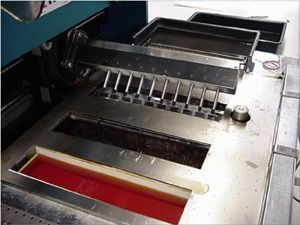
Robotic Hot Solder Dip using the Flexline®
Who This Service Is For
Hot Solder Dip is a piece-part (component-level) service. It is the right fit when you need to:
- Integrate commercial-off-the-shelf (COTS) components into military, aerospace, or space programs that prohibit pure tin finishes
- Convert lead finishes, restore solderability, or prevent tin whiskers on individual piece parts
- Process piece parts to GEIA-STD-0006 for product applications that require significant control
This service is not intended for:
- Board-level assemblies or in-circuit rework — Six Sigma processes components and piece parts, not populated circuit boards
Why Tin Whiskers Matter
The electronics industry's transition to lead-free finishes resulted in widespread use of pure tin-plated component terminations. While environmentally beneficial, pure tin finishes introduced a significant reliability concern for high-reliability applications: tin whisker formation.
Tin whiskers are conductive filament-like structures that can spontaneously grow from pure tin surfaces over time. These whiskers have been linked to electrical shorts, intermittent failures, and system-level reliability issues in mission-critical applications. As a result, many aerospace, defense, and space programs restrict or prohibit the use of pure tin-finished components.
Hot Solder Dip remains one of the most effective tin whisker mitigation strategies because it removes the pure tin finish and replaces it with a more reliable solder alloy, eliminating the risk of whisker-related failures.
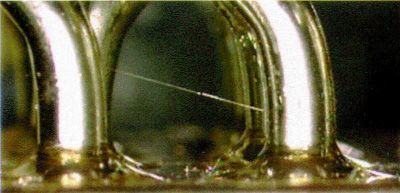
Tin Whiskers
Not All Hot Solder Dip Processes Are Equal
While Hot Solder Dip is conceptually simple, the process introduces significant thermal energy into the component. Poorly designed solder dip processes can create severe thermal gradients within a package, potentially leading to both immediate and latent defects.
Potential risks include:
- Die cracking
- Wire bond damage
- Package warpage
- Delamination
- Internal stress generation
- Flux entrapment
- Corrosion mechanisms
- Conductive anodic filament growth
Many HSD providers focus exclusively on lead finish replacement while overlooking the thermal stresses introduced during processing. At Six Sigma, thermal management is a fundamental part of the process design. Our engineers have conducted extensive research into heat transfer during Hot Solder Dip processing, including finite element modeling and experimental validation studies to better understand temperature distribution within electronic components.
Minimizing Thermal Gradients Through Controlled Processing
Research performed by Six Sigma demonstrated that thermal gradients within electronic packages can be dramatically reduced through carefully controlled preheat and cooldown profiles. Components exposed to rapid temperature changes experience significantly greater internal temperature differentials than those processed using gradual thermal transitions.
For this reason, Six Sigma robotic Hot Solder Dip process emphasizes:
- Controlled preheating
- Optimized flux activation
- Precisely controlled immersion depth
- Controlled dwell times
- Gradual cooling profiles
- Continuous process monitoring
- Package-specific process development
By minimizing thermal shock, Six Sigma helps reduce the risk of latent damage while maintaining the solderability and finish conversion benefits of Hot Solder Dip processing.
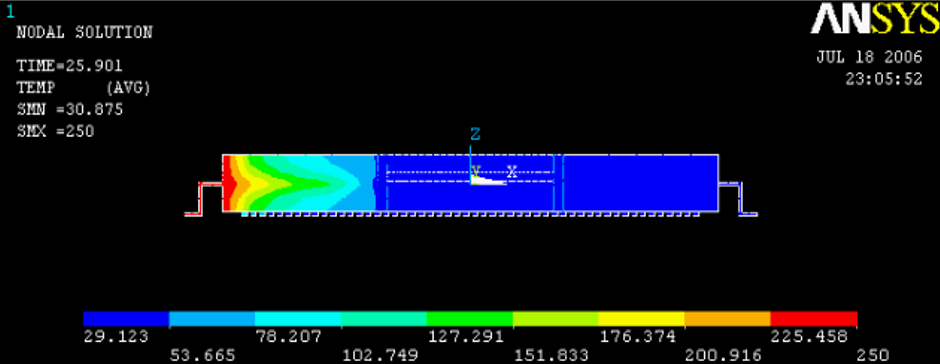
Thermal simulation during Solder Dip
Advantages of Robotic Hot Solder Dip
There are several methods used throughout the industry to perform Hot Solder Dip processing. However, robotic systems provide significant advantages for high-reliability applications because they allow precise control of every process variable.
Six Sigma robotic systems provide control over:
- Immersion depth
- Immersion angle
- Dwell time
- Withdrawal speed
- Lead orientation
- Solder contact time
- Process repeatability
This level of control produces more consistent solder coatings while reducing process variability from lot to lot.
Robotic systems also maintain controlled temperature profiles and precise control over dip depth and dwell times, which supports better quality control and reduces the risk of manufacturing defects in the finished electronics.
Key benefits include:
- Uniform coating thickness
- Improved solderability
- Enhanced process repeatability
- Reduced operator variability
- Improved quality control
- Better documentation and traceability
- Consistent production results
- These advantages are particularly important for aerospace, defense, and spaceflight hardware where process repeatability is essential.

Flexline Robotic Hot Solder Dip
Lead Finish Conversion
Many electronic components are supplied with finishes that may not be compatible with a customer's assembly process or reliability requirements.
Lead Finish Conversion allows customers to replace existing finishes with solder alloys tailored to their application requirements. This capability is particularly important when integrating commercial-off-the-shelf (COTS) components into military or aerospace programs that prohibit pure tin finishes.
Typical conversion applications include:
- Pure tin to Sn63Pb37
- Lead-free to leaded conversion
- Leaded to lead-free conversion
- Custom solder alloy applications
The result is a component termination finish better suited for long-term reliability and assembly compatibility.
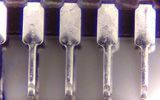
Typical solder finish on component leads
Processing to GEIA-STD-0006
GEIA-STD-0006 defines the requirements for fully replacing undesirable surface finishes using robotic hot solder dip, along with the requirements for qualifying and testing the refinished piece parts. The standard covers replacing pure tin and Pb-free tin alloy finishes with SnPb finishes for subsequent assembly with SnPb solder. Sn63Pb37 (eutectic tin-lead) is the alloy most commonly specified for military hot solder dip. The standard covers the process and testing requirements for a robotic dipping process and does not cover semi-automatic or purely manual dipping processes.
The standard applies to refinishing performed by a robotic hot solder dip service supplier, or by production facilities at the customer's site — not to piece part manufacturers that initially build piece parts with a hot solder dip finish. Its intent is for suppliers and customers to incorporate these requirements into their operations to provide a consistent, well-controlled process for product applications that require significant control.
Piece parts processed to the standard exhibit enhanced solderability and solder joint reliability compared to most COTS finishes, in addition to the elimination of tin whisker risks. Because complete conversion removes the original finish, Pb-free tin piece parts dipped in compliance with the standard are no longer considered Pb-free tin finished.
The standard does not guarantee a particular yield or reliability of piece parts going through solder dipping, and some applications have unique requirements that exceed its scope and should be specified separately. Replacement of BGA spheres or CGA columns is not within the scope of GEIA-STD-0006; Six Sigma performs those as dedicated Ball Attach and Column Attach services.
Solderability Restoration and Obsolescence Management
Long-term storage can result in oxidation, contamination, and degradation of component lead finishes. As components age, solderability often becomes a significant concern, particularly for obsolete and difficult-to-source devices.
Hot Solder Dip processing restores solderability by removing degraded surface finishes and replacing them with fresh solder coatings capable of supporting reliable assembly operations.
This capability allows customers to:
- Recover aging inventory
- Extend component usability
- Preserve valuable assets
- Reduce component waste
- Support long-life defense and aerospace programs
For many obsolete components, Hot Solder Dip provides a cost-effective alternative to redesigning hardware or qualifying replacement parts.
More Than 22 Million Devices Processed Since 1990
Experience matters when processing components destined for mission-critical applications.
With more than 22 million devices successfully processed since 1990, Six Sigma Microelectronics has developed one of the industry's most extensive knowledge bases in Robotic Hot Solder Dip, Lead Finish Conversion, Tin Whisker Mitigation, Solderability Restoration, and High-Reliability Component Processing.
Six Sigma combination of proprietary robotic equipment, thermal management expertise, process controls, and decades of aerospace and defense experience enables customers to confidently address lead finish and solderability challenges while maintaining the reliability required for mission-critical electronic systems.
Whether you are mitigating tin whisker risks, restoring solderability to aging inventory, converting lead finishes, or qualifying components for military and aerospace applications, Six Sigma Microelectronics can help identify the optimal Hot Solder Dip solution for your program.

How the Process Works
1. Request a Quote. Send your component details, quantities, incoming finish, and target alloy. Our engineers review feasibility and requirements.
2. Engineering Review and Qualification. We confirm the process approach, package suitability, and applicable requirements (including GEIA-STD-0006 where specified), then qualify the process for your parts.
3. Processing, Inspection and Delivery. Components are processed on our robotic systems, then inspection verifies coating integrity and coverage. Parts are documented for traceability and returned ready for subsequent assembly.
- Recover aging inventory
- Extend component usability
- Preserve valuable assets
- Reduce component waste
- Support long-life defense and aerospace programs
For many obsolete components, Hot Solder Dip provides a cost-effective alternative to redesigning hardware or qualifying replacement parts.
Why Programs Trust Six Sigma
More than 22 million devices have been processed since 1990. Decades of aerospace and defense flight heritage. Proprietary robotic equipment and thermal-management expertise built specifically for high-reliability applications where failure is not an option.