
BGA Reballing and Ball Attach Services
Trusted BGA Reballing Services Since 1997
For more than 25 years, Six Sigma Microelectronics has provided Ball Attach Services and BGA Reballing Services for aerospace, defense, satellite, medical, industrial, telecommunications, and other high-reliability electronic applications.
Since 1997, Six Sigma Microelectronics has successfully processed more than 3 million reballed BGA devices, supporting customers ranging from prototype development programs to long-life production systems. Six Sigma's experience spans thousands of component package types, solder alloys, and manufacturing technologies, allowing Six Sigma to provide reliable solutions for obsolescence mitigation, solderability restoration, alloy conversion, and component salvage.
Unlike many rework providers, Six Sigma Microelectronics approaches BGA Reballing as both a manufacturing process and an engineering discipline. Every component design presents unique challenges, and understanding the limitations of the package is often just as important as performing the reballing operation itself.
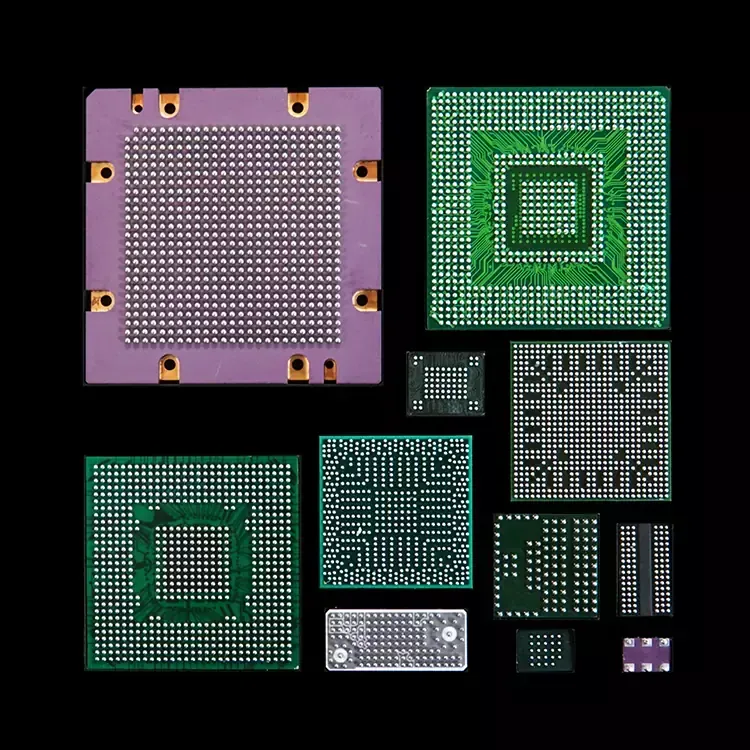
Examples of BGA devices processed by Six Sigma
What Is BGA Reballing?
BGA Reballing is the process of removing existing solder spheres (balls) from a Ball Grid Array (BGA) package and replacing them with new solder balls. The process restores the package interconnect structure — the solder balls that form the electrical and mechanical connections between the BGA component and the printed circuit board (PCB) — and prepares the component for future assembly operations.
BGA Reballing may be performed for several reasons, including:
- Solderability restoration
- Lead-free to tin-lead conversion
- Tin-lead to lead-free conversion
- Obsolescence mitigation
- Component salvage
- Damage repair
- Reliability enhancement
- Package modification
- Assembly process compatibility
When properly executed,
BGA Reballing can extend component life, enable the safe reuse of valuable inventory, and support continued production of systems where replacement components are difficult or impossible to obtain.
The BGA Reballing Process
Every BGA reballing project follows a controlled, documented reballing process designed to return each component to its original specifications while limiting thermal stress on the package.
1. Incoming Inspection —
Each lot receives a visual inspection to verify ball count, package condition, and markings against customer specifications before processing begins.
2. Solder Ball Removal — A robotic wave soldering system removes the existing solder balls by passing the component over a controlled wave of molten solder, effectively dissolving the solder balls while protecting the underlying pad metallization.
3. Ball Placement and Alignment — New solder balls are placed using precision stencils or ball-placement tooling, ensuring the spheres are perfectly aligned with uniform height and ball pitch across the package.
4. Reflow — The new balls are reflowed using controlled temperature profiles to form reliable metallurgical connections without overstressing the component.
5. Final Inspection and Testing — Completed components are inspected and tested to confirm alignment, uniformity, and solder joint integrity before shipment.

BGA, Preform, & Fixture
Quality Assurance, Inspection, and Reliability Testing
Quality assurance inspection and testing are critical steps in the BGA reballing process. Every lot is verified against industry specifications and customer specifications to confirm the alignment, uniformity, and integrity of the new solder balls.
Available inspection and testing services include:
- Visual inspection of ball placement, alignment, and package condition
- X-ray fluorescence (XRF) verification of solder alloy composition
- Ball shear testing to verify the mechanical strength of attached solder balls
- Solderability testing
- 3D X-ray inspection and scanning acoustic microscopy through our in-house Analytical Services
- High-precision optical CMM measurement of coplanarity, true position, ball height, and ball diameter
These in-house testing services help ensure consistent performance and highly reliable solder connections when reballing BGAs for high-performance aerospace and defense applications.

Optical CMM Measurement of BGAs
Comprehensive Ball Attach Services
Six Sigma Microelectronics provides precision Ball Attach Services for a wide range of package types, ball pitches, and electronic grade solder alloy requirements.
Our capabilities include:
- Ball Grid Array Reballing
- Custom Ball Attach
- Alloy Conversion
- Fine-Pitch BGA Processing
- Prototype and Production Quantities
- High-Reliability Component Processing
- Obsolescence Mitigation Support
- Engineering Evaluation and Risk Assessment
We routinely attach and replace solder spheres using tin-lead and lead-free solder alloys, including:
- Sn63-Pb37
- Sn10-Pb90
- SAC305
- SACQ
Each project is reviewed to ensure compatibility with customer specifications, industry specifications, assembly processes, reliability objectives, and end-use applications.
Why Customers Use BGA Reballing
Electronic component availability challenges, aging inventory, evolving assembly requirements, and long product life cycles frequently create situations where BGA Reballing provides significant value.
Extend Component Life
Reballing can restore older inventory that may otherwise be unusable due to oxidized solder balls, handling damage, or degraded solderability.
Support Obsolescence Programs
Many aerospace and defense systems remain in service for decades. Reballing can help preserve difficult-to-source components that are no longer available from original manufacturers and support long-term sustainment programs.
Improve Solderability
Replacing aged solder spheres with fresh solder balls helps ensure reliable solder reflow and attachment during board-level manufacturing.
Enable Alloy Conversion
Reballing allows components to be converted between solder alloys to support customer-specific assembly processes and reliability requirements.
Reduce Program Risk
Maintaining a supply of qualified components can help avoid costly redesigns, qualification efforts, and schedule delays.

Ball Grid Array (BGA) Component
Not Every Component Should Be Reballed
One of the most important lessons learned from processing more than 3 million BGA devices is that not every component is a good candidate for reballing.
While many suppliers treat reballing as a routine BGA rework process, Six Sigma Microelectronics evaluates each package design individually to determine whether reballing can be performed safely and reliably.
A critical consideration is the metallization structure of the component pad. Many modern BGA packages utilize a nickel barrier layer beneath the solderable surface finish. This nickel barrier helps protect the underlying copper pad from excessive dissolution during solder reflow and rework operations.
However, some package designs rely primarily on exposed copper pad structures with limited protection against repeated thermal exposure. In these cases, multiple rework cycles can progressively consume the copper pad through dissolution into the solder alloy. Excessive copper loss can weaken the interconnect structure and potentially compromise long-term reliability.
For this reason, a successful reballing strategy requires more than simply replacing solder spheres. It requires understanding:
- Package construction
- Pad metallization systems
- Solder alloy compatibility
- Previous rework history
- Thermal exposure limits
- Reliability requirements
- End-use environment
In some situations, a single reball cycle may be appropriate. In others, multiple rework cycles may be safely performed. In still other cases, reballing may not be recommended at all.
Our engineering team evaluates these factors before processing begins and works closely with customers to recommend the most reliable path forward.
Typical conversion applications include:
Engineering-Driven Reballing Expertise
Decades of experience processing aerospace, defense, and high-reliability components have allowed Six Sigma Microelectronics to develop extensive knowledge of package construction, metallization systems, solder alloy behavior, and rework limitations.
This expertise enables us to:
- Characterize component package designs
- Evaluate rework feasibility
- Assess pad metallization risks
- Determine appropriate solder alloys
- Recommend allowable rework cycles
- Identify potential reliability concerns before processing
By combining engineering analysis with proven manufacturing processes, we help customers make informed decisions that balance cost, availability, and long-term reliability.

BGA Component
Industry Standards and Compliance
BGA reballing for aerospace and defense electronic systems is governed by established industry specifications and customer specifications.
IPC J-STD-006 defines the requirements for electronic-grade solder alloys and non-fluxed solid solders used in electronic soldering applications. IPC J-STD-033 defines the handling, packing, and shipping requirements for moisture-sensitive devices.
IEC TS 62647-4 outlines process management requirements for aerospace and defense electronic systems containing lead-free solder, with specific provisions for BGA re-balling in avionics applications.
MIL-STD-883 test methods establish uniform methods for testing microelectronic devices and components, ensuring they meet military and aerospace requirements for reliability and performance.

BGA Standards
BGA, Preform, & Fixture
Aerospace and Defense Experience
Six Sigma Microelectronics' Ball Attach Services support defense electronic systems and other applications where reliability is critical and component replacement may be impossible after deployment.
Our services support:
- Aerospace electronics
- Defense systems
- Satellite programs
- Spaceflight hardware
- Military avionics
- Medical electronics
- Industrial controls
- Telecommunications infrastructure
Many of these applications are expected to operate reliably for years or decades, making component integrity a critical requirement.

More Than 3 Million Reballed Devices Since 1997
Experience matters when processing valuable and difficult-to-source electronic components.
With more than 3 million reballed BGA devices successfully processed since 1997, Six Sigma Microelectronics remains a trusted source for Ball Attach and Reballing Services — including BGA Reballing Services, BGA Sphere Replacement, Alloy Conversion, Solderability Restoration, Obsolescence Mitigation, and High-Reliability Component Processing.
Whether you need a straightforward solder sphere replacement or a detailed engineering assessment of a complex package design, our engineers and expert technicians can help determine the most reliable solution for your application.